Saturday morning I drove to Takachiho to see a chiropractor. A fellow JET (Gracias, Eto!) recommended him months ago, and luckily I remembered the doc's name. I went to see him primarily because I was hoping he could help me get rid of my chilblains or whatever it is that's irritating my fingers and toes.
The first time I saw a chiropractor was about two or three years ago, while I was living in South Carolina. Back then, I had no special reason for going in for treatment. But I figured I had nothing to lose. And it made sense to me that having my body checked out by a doctor could only be beneficial.
I felt good about the initial treatment I received in SC and ended up going back to that chiropractor for further "adjustments" every few months or so. At about 35 bucks a pop (as in "visit," not as in, hee hee, "each of the sounds coming from my back and neck"!), I considered the money well spent. Especially since I had no health insurance at the time.
I figured my experience at the chiropractor's in Japan would be about the same as my experience in SC. Boy was I wrong!
What an amazing setup this guy had! The doc briefly examined my fingers and toes and then prescribed 17 minutes of electrotherapy(!). So I lay down on a bed, a couple of nurses (yes, nurses!) hooked me up to a machine, and before I knew it I felt this odd electric stimulation in my arms (I didn't really feel any stimulation in my legs). Cool.
Next, I headed on over to one of the massage beds. Wow, that was really something! How should I describe that? Hmmm... I guess it was kind of as if my body was a package going for a ride on a rolling conveyor system at a UPS sorting plant, only the rolls kept changing sizes. That treatment lasted for about 10 minutes and was rather relaxing.
After that, the doc finally got to the "adjustment" bit: I lay face down on a bench, and then the doc massaged my back and neck before going to work on me, crunching here and twisting there. After a few minutes, my session was over. And when I stood back up, my fingers and toes were miraculously cured!
Not! Even today, more than 48 hours after my appointment, I still have redness in my fingers and toes. But I tell you, my toes aren't nearly as irritated. And I'm a bit more confident now that my "problem" will go away soon.
Oh, and perhaps the greatest thing about the visit was the price: 870 yen (roughly $8.50/EUR 5.50)! What's more: Subsequent treatments will only cost 460 yen! (Last week when I visited the doctor who prescribed that cream for me, I paid about 1500 yen for the privilege of seeing the doc and 770 for three 20g tubes of Hirudoid cream.) "How so?", you ask?
Well, Mr. President, I'm glad you asked. The low price is due to something called "health insurance for all," and comes in the form of a little credit-card sized card I carry with me. Insurance covers 70%, while I pay the remaining 30%. What an amazing concept. I seem to remember that those Europeans over there in Europe, you know, that far-away land across the Ata-lantic Ocean -- no, no, not the one to our left, the one to our right -- have the same type of system in place. If it works for them, don't you think it can work for us?
Monday, March 17, 2008


Sunday, March 16, 2008
It's Time for Graduation -- Yes, In March
The Japanese fiscal year starts on April 1. So does the school year. Which means that graduation is in March.
I got my first taste of Japanese-style graduation not at my school but rather at Takachiho High School, lo cated about 10 miles east of Gokase. Why? Well, according to a guy I spoke to on graduation day at my school, every high school in my prefecture, Miyazaki prefecture, holds its graduation ceremony on March 1. Except for my school. My school always has its commencement ceremony on March 3. I'm not sure why my school goes by a slightly different schedule, but I guess the reason must have something to do with the fact that my school is the only "secondary school" (combined junior and senior high school) in the prefecture.
Anyway, since March 1 happened to fall on a Saturday this year, I had the day off. So I went to Takachiho to see what graduation was like. Graduation was held at the school, in the gymnasium. The graduating class consisted of approximately 200 students. (By the way, high schools in Japan typically have students in grades 10-12, but they are considered to be in grades 1-3.)
One of the main differences between graduation in Japan and graduation in America is that here everyone in attendance will end up going through the ritual of standing up, bowing, listening to someone talk for anywhere from a couple seconds to several minutes, bowing again, and sitting back down at least once. How many times you have to do that depends on whether or not you are a graduating senior, a fellow student, a member of the staff, a VIP, or a guest.
At one point during the ceremony, the students stood up and sat back down so many times within a couple of minutes, I had the feeling they were actually at basic training, being yelled at by their drill instructor: "ON YOUR FEET!" (Not everyone stands up at the same time.) "WHAT THE ...?! SIT BACK DOWN! NOW, LET'S TRY THAT AGAIN! ON YOUR FEET!" Up and down, up and down they go(!), forced to go through the drill several times, until they get it just right. Except here at graduation, there's no drill instructor, just some guy at the microphone. And here there's no yelling, just some quiet commands.
Another thing that one notices at a graduation in Japan is that almost everyone in attendance who is dressed up in a suit and tie is wearing tennis shoes, slippers, or just socks. That is of course due to the fact that you can't wear your outdoor shoes inside the gym. I find that style rather amusing, but by now I've gotten used to the fashion. So when I dress up, I don't bother to wear formal shoes, because as soon as I get indoors, I'll have to switch to slippers. (How do you like those bright blue shoes I'm wearing with my suit?)
Another thing I noticed right away about graduation was the priority given to males. In Takachiho, for instance, the boys who weren't graduating sat in front of the girls who weren't graduating. (At least in Gokase, the girls sat on the left and t he boys sat on the right.) And when the seniors marched into the gym, the boys came in first, followed by the girls. The boys also went onstage first to receive their diplomas, at least in Gokase that is. (At Takachiho High School, only six students, each one representing a homeroom, went onstage to accept the diplomas for the rest of the students. And can guess how many of those reps were girls? Wrong. Not zero. But just one.) And there were far more male VIPs than female VIPs. (In Gokase, about 19 male VIPs were introduced before the first female VIP was introduced, and there were only about 5 females among the 50 or so VIPs.) Even the yearbook gives priority to the boys, with their pages coming before the girls' pages (at least in Gokase).
Here a several other notes about graduation in Japan, as least based on the two ceremonies I witnessed:
At least one member of the audience, a parent, addresses the students.
For whatever reason, each diploma is numbered and the numbers are read to the audience. (The numbers correspond to the number of students who have graduated in th e history of the school up to that point.)
All the boring speeches come after the students receive their diplomas, not before.
Several songs are sung, not just the school's alma mater.
After graduation, it's tradition to toss the seniors into the air, one by one. The male seniors, that is.
I got my first taste of Japanese-style graduation not at my school but rather at Takachiho High School, lo
 cated about 10 miles east of Gokase. Why? Well, according to a guy I spoke to on graduation day at my school, every high school in my prefecture, Miyazaki prefecture, holds its graduation ceremony on March 1. Except for my school. My school always has its commencement ceremony on March 3. I'm not sure why my school goes by a slightly different schedule, but I guess the reason must have something to do with the fact that my school is the only "secondary school" (combined junior and senior high school) in the prefecture.
Anyway, since March 1 happened to fall on a Saturday this year, I had the day off. So I went to Takachiho to see what graduation was like. Graduation was held at the school, in the gymnasium. The graduating class consisted of approximately 200 students. (By the way, high schools in Japan typically have students in grades 10-12, but they are considered to be in grades 1-3.)
One of the main differences between graduation in Japan and graduation in America is that here everyone in attendance will end up going through the ritual of standing up, bowing, listening to someone talk for anywhere from a couple seconds to several minutes, bowing again, and sitting back down at least once. How many times you have to do that depends on whether or not you are a graduating senior, a fellow student, a member of the staff, a VIP, or a guest.
At one point during the ceremony, the students stood up and sat back down so many times within a couple of minutes, I had the feeling they were actually at basic training, being yelled at by their drill instructor: "ON YOUR FEET!" (Not everyone stands up at the same
 time.) "WHAT THE ...?! SIT BACK DOWN! NOW, LET'S TRY THAT AGAIN! ON YOUR FEET!" Up and down, up and down they go(!), forced to go through the drill several times, until they get it just right. Except here at graduation, there's no drill instructor, just some guy at the microphone. And here there's no yelling, just some quiet commands.
Another thing that one notices at a graduation in Japan is that almost everyone in attendance who is dressed up in a suit and tie is wearing tennis shoes, slippers, or just socks. That is of course due to the fact that you can't wear your outdoor shoes inside the gym. I find that style rather amusing, but by now I've gotten used to the fashion. So when I dress up, I don't bother to wear formal shoes, because as soon as I get indoors, I'll have to switch to slippers. (How do you like those bright blue shoes I'm wearing with my suit?)
Another thing I noticed right away about graduation was the priority given to males. In Takachiho, for instance, the boys who weren't graduating sat in front of the girls who weren't graduating. (At least in Gokase, the girls sat on the left and t
 he boys sat on the right.) And when the seniors marched into the gym, the boys came in first, followed by the girls. The boys also went onstage first to receive their diplomas, at least in Gokase that is. (At Takachiho High School, only six students, each one representing a homeroom, went onstage to accept the diplomas for the rest of the students. And can guess how many of those reps were girls? Wrong. Not zero. But just one.) And there were far more male VIPs than female VIPs. (In Gokase, about 19 male VIPs were introduced before the first female VIP was introduced, and there were only about 5 females among the 50 or so VIPs.) Even the yearbook gives priority to the boys, with their pages coming before the girls' pages (at least in Gokase).
Here a several other notes about graduation in Japan, as least based on the two ceremonies I witnessed:
At least one member of the audience, a parent, addresses the students.
For whatever reason, each diploma is numbered and the numbers are read to the audience. (The numbers correspond to the number of students who have graduated in th
 e history of the school up to that point.)
All the boring speeches come after the students receive their diplomas, not before.
Several songs are sung, not just the school's alma mater.
After graduation, it's tradition to toss the seniors into the air, one by one. The male seniors, that is.
Friday, March 14, 2008
The "Gokase Effect" and Opening Doors
This morning, like just nearly every morning, one of the first things I did after waking up (around 7:15 a.m.) was to check the outdoor temperature. I slid open the kitchen window and was happy to see the thermometer displaying a whopping 12 degrees C (about 54 F). What a relief! For the greater part of the winter, the temperature has been hovering a lot closer to 0 in the morning. When I told Moto one day last week as we started our walk to school that the temperature was 6, he said, "Before I came to Gokase, 6 degrees was really cold. Now 6 degrees is really warm!" Well, Moto, I guess you can call that the "Gokase Effect."
As we approached the school today, we saw another teacher, Mr. N., walking to school. He is one of the teachers who lives in the apartment building that is just a stone's throw away from school. Today was the second time I'd seen him walking to school, but I suspect he does so rather often. Moto mentioned to me that Mr. N. had spent some time (2 or 3 years?) in Holland and, as a result, has become fairly ecologically-aware. Moto told me another way Mr. N. tries to help out the environment: At lunchtime, he drinks his milk out of a plastic cup that he brings along, rather th an using the straw that comes with the milk carton, as almost everyone else does. (When I drink the milk, I just open up the carton and drink away. Why the milk company attaches straws to the cartons is beyond me. Such waste!)
Talking about Mr. N. with Moto led to a brief discussion of the importance that learning English has for the Japanese. Without English, the Japanese are stuck on their little island. With English, they can travel the world. Which reminds me of a saying I've heard about Dominican (and Cuban?) baseball players: "You can't walk off the island." If the Dominican baseball players want to find out what the rest of the world is like, they have to swing the bat. If the Japanese want to find out what the rest of the world is like, they have to learn English.
Which brings me back to me learning Japanese. I'm certainly spending time trying to learn the language, but I'm not progressing as fast as I want to. But I guess I'm doing great for someone who pretty much knew no Japanese before he came here. And I've only been here about seven months. So I have to be patient. But it's not much fun when you usually barely understand what's going on around you.
Right now, for instance, some of the kids from my school are making short presentations. I listened to one of them and was able to follow along a bit because of the overheads he used. But all I got was the gist. Don't ask me why everyone was laughing.

The other day I met an American guy named Byron. He used to be a JET like me, here in Gokase. He's an amazing character. He plays the sanshin (an Okinawan guitar) and is basically fluent in Japanese. He reminded me of myself when I'm in Germany or Austria, at least as far as speaking the local language goes. You simply get so much more out of living abroad if you speak the local language. So I yearn for the day when I, too, am fluent in Japanese. Think of how many doors being fluent in Japanese will open up for me...
Speaking of opening doors, when I got to school today, the sliding doors at the main entrance were shut, as usual, despite the fact that this is probably the warmest day of the year. When I walked in, I decided to slide them all the way open. I'm happy to report that 2 hours later they are still wide open.

My next door-related goal is to get the other teachers to leave the sliding doors to the teachers' room open, but that will take more work. I'm all for closing doors when it's cold, but it's not cold any more. And there is so much foot traffic coming and going, it would make a lot more sense to just leave the doors open all the time, as they are in the summer. Besides, so many teachers and students close the doors without even looking to see if anyone else is about to pass through. So just as one person closes the doors, another one is inevitably opening them. It's pretty ridiculous, especially since you can see right through the doors.
What's worse is when a teacher closes a door in your face, almost as if he or she is trying to spite you. I was flabbergasted when a teacher did just that to me a couple weeks ago. She was approaching the main entrance just before me. We even greeted each other with the ol' "ohayo gozaimasu" ("good morning"). She slid the door open, walked in, and slid the door shut. I was about 2 seconds behind her.
The same goes for when the teachers are on their way to lunch. One by one, it seems, they go out the door, each one of them closing it behind them, only for the next person to repeat the process.

You might think that the teachers are so obsessed with keeping the main doors closed around here because the heaters are running and they are trying to keep the warmth inside. If that's the case, how come most of the other doors all over the school are almost always wide open?
By the way, I don't feel bad about bailing on those presentations I mentioned earlier. Because more and more teachers are showing up in the teachers' office. Even though the presentations are still going on. As a matter of fact, the entire day's schedule is filled with presentations of some sort or other. Perhaps I should get back to studying Japanese.
As we approached the school today, we saw another teacher, Mr. N., walking to school. He is one of the teachers who lives in the apartment building that is just a stone's throw away from school. Today was the second time I'd seen him walking to school, but I suspect he does so rather often. Moto mentioned to me that Mr. N. had spent some time (2 or 3 years?) in Holland and, as a result, has become fairly ecologically-aware. Moto told me another way Mr. N. tries to help out the environment: At lunchtime, he drinks his milk out of a plastic cup that he brings along, rather th
 an using the straw that comes with the milk carton, as almost everyone else does. (When I drink the milk, I just open up the carton and drink away. Why the milk company attaches straws to the cartons is beyond me. Such waste!)
Talking about Mr. N. with Moto led to a brief discussion of the importance that learning English has for the Japanese. Without English, the Japanese are stuck on their little island. With English, they can travel the world. Which reminds me of a saying I've heard about Dominican (and Cuban?) baseball players: "You can't walk off the island." If the Dominican baseball players want to find out what the rest of the world is like, they have to swing the bat. If the Japanese want to find out what the rest of the world is like, they have to learn English.
Which brings me back to me learning Japanese. I'm certainly spending time trying to learn the language, but I'm not progressing as fast as I want to. But I guess I'm doing great for someone who pretty much knew no Japanese before he came here. And I've only been here about seven months. So I have to be patient. But it's not much fun when you usually barely understand what's going on around you.
Right now, for instance, some of the kids from my school are making short presentations. I listened to one of them and was able to follow along a bit because of the overheads he used. But all I got was the gist. Don't ask me why everyone was laughing.

The other day I met an American guy named Byron. He used to be a JET like me, here in Gokase. He's an amazing character. He plays the sanshin (an Okinawan guitar) and is basically fluent in Japanese. He reminded me of myself when I'm in Germany or Austria, at least as far as speaking the local language goes. You simply get so much more out of living abroad if you speak the local language. So I yearn for the day when I, too, am fluent in Japanese. Think of how many doors being fluent in Japanese will open up for me...
Speaking of opening doors, when I got to school today, the sliding doors at the main entrance were shut, as usual, despite the fact that this is probably the warmest day of the year. When I walked in, I decided to slide them all the way open. I'm happy to report that 2 hours later they are still wide open.

My next door-related goal is to get the other teachers to leave the sliding doors to the teachers' room open, but that will take more work. I'm all for closing doors when it's cold, but it's not cold any more. And there is so much foot traffic coming and going, it would make a lot more sense to just leave the doors open all the time, as they are in the summer. Besides, so many teachers and students close the doors without even looking to see if anyone else is about to pass through. So just as one person closes the doors, another one is inevitably opening them. It's pretty ridiculous, especially since you can see right through the doors.
What's worse is when a teacher closes a door in your face, almost as if he or she is trying to spite you. I was flabbergasted when a teacher did just that to me a couple weeks ago. She was approaching the main entrance just before me. We even greeted each other with the ol' "ohayo gozaimasu" ("good morning"). She slid the door open, walked in, and slid the door shut. I was about 2 seconds behind her.
The same goes for when the teachers are on their way to lunch. One by one, it seems, they go out the door, each one of them closing it behind them, only for the next person to repeat the process.

You might think that the teachers are so obsessed with keeping the main doors closed around here because the heaters are running and they are trying to keep the warmth inside. If that's the case, how come most of the other doors all over the school are almost always wide open?
By the way, I don't feel bad about bailing on those presentations I mentioned earlier. Because more and more teachers are showing up in the teachers' office. Even though the presentations are still going on. As a matter of fact, the entire day's schedule is filled with presentations of some sort or other. Perhaps I should get back to studying Japanese.
Wednesday, March 12, 2008
Add a new word to your vocabulary: chilblains.
Over here, they call it both shimoyake and, mistakenly, frostbite. But it's actually chilblains.
For several months now, probably since the beginning of winter, my fingers and toes have been suffering. Du ring this time, my fingers and toes have usually been a bright red or a nasty-looking blue, and occasionally they feel like they are on fire. The skin on my fingers has also been rather dry, and my fingers have sometimes been slightly swollen.
I've had this condition before, but never to this degree. The other times it's happened, I thought there was some sort of tie-in to the fact that I was doing a lot of swimming in public pools at the time. I figured I must be allergic to chlorine or the chemicals in the swimming pools or whatever. The condition never lasted very long and didn't seem to have anything to do with the weather.
So this time, when my condition started, I also thought perhaps the ol' chlorine allergy was kicking in again, especially since I was swimming once or twice a week at the time. So for a while, I quit swimming. But that had no noticeable effect on my skin's condition.
My next hypothesis was that perhaps a pair of my shoes that I wore rather often was at fault regarding the condition of my toes. I figured that maybe the shoes were ol d and perhaps crawling with nasty bacteria or something. So I bought a new pair of shoes. But that also failed to cure the condition of my toes.
Could it be the socks I was wearing? Were they irritating my skin? To find out, I did a little (unscientific) experiment. Last week for about three days, I wore a sock on my right foot and went without a sock on my left foot. Oddly, both feet felt great. So that experiment didn't solve my problem, either.
Of course, even if I had discovered that my shoes or socks were the culprit regarding my toes, how would that explain my red fingers?
Is it really the cold weather that's causing the problem? That doesn't make much sense to me, because as cold as it is here, I've lived in much colder places and never had such trouble with my fingers and toes. And I almost always wear gloves outside. And I've been wearing two or three pairs of socks at once to keep my toes warm.

Nevertheless, I've been patiently waiting for the weather to warm up to see if my problem will slowly go away as the temperatures rise. But that's not happening fast enough.
So I finally went to see a doctor yesterday. First, a nurse scraped some skin off my toes and examined it under a microscope to look for signs of mold. Negative on that. Then, the doctor came in and looked at my fingers and toes. Within two seconds he said, "shimoyake."
Several weeks ago, I showed my hands to a junior-high-school student. Within two seconds, he said the same thing: shimoyake. And after I got back from the hospital yesterday, I showed my hands to Moto. He also immediately said, "shimoyake."
I don't get it. If I showed you my fingers and my toes, would you say, without hesitation, "chilblains?" Would you immediately think the redness was caused by the cold? Or would you wonder if I burned my skin, or were allergic to something, or was bitten by an insect, or touched poison oak, or ...? How can everyone here come to the same instant conclusion? Is shimoyake a bizarre Japanese disease that everyone gets at some point in their life?
For now, I'm using a cream that the doctor prescribed. But I'm also going to go see a chiropractor. And I'm thinking about getting a massage. And perhaps I'll even give acupuncture a shot. After all, the cream is just a remedy. I want to find a cure.
For several months now, probably since the beginning of winter, my fingers and toes have been suffering. Du
 ring this time, my fingers and toes have usually been a bright red or a nasty-looking blue, and occasionally they feel like they are on fire. The skin on my fingers has also been rather dry, and my fingers have sometimes been slightly swollen.
I've had this condition before, but never to this degree. The other times it's happened, I thought there was some sort of tie-in to the fact that I was doing a lot of swimming in public pools at the time. I figured I must be allergic to chlorine or the chemicals in the swimming pools or whatever. The condition never lasted very long and didn't seem to have anything to do with the weather.
So this time, when my condition started, I also thought perhaps the ol' chlorine allergy was kicking in again, especially since I was swimming once or twice a week at the time. So for a while, I quit swimming. But that had no noticeable effect on my skin's condition.
My next hypothesis was that perhaps a pair of my shoes that I wore rather often was at fault regarding the condition of my toes. I figured that maybe the shoes were ol
 d and perhaps crawling with nasty bacteria or something. So I bought a new pair of shoes. But that also failed to cure the condition of my toes.
Could it be the socks I was wearing? Were they irritating my skin? To find out, I did a little (unscientific) experiment. Last week for about three days, I wore a sock on my right foot and went without a sock on my left foot. Oddly, both feet felt great. So that experiment didn't solve my problem, either.
Of course, even if I had discovered that my shoes or socks were the culprit regarding my toes, how would that explain my red fingers?
Is it really the cold weather that's causing the problem? That doesn't make much sense to me, because as cold as it is here, I've lived in much colder places and never had such trouble with my fingers and toes. And I almost always wear gloves outside. And I've been wearing two or three pairs of socks at once to keep my toes warm.

Nevertheless, I've been patiently waiting for the weather to warm up to see if my problem will slowly go away as the temperatures rise. But that's not happening fast enough.
So I finally went to see a doctor yesterday. First, a nurse scraped some skin off my toes and examined it under a microscope to look for signs of mold. Negative on that. Then, the doctor came in and looked at my fingers and toes. Within two seconds he said, "shimoyake."
Several weeks ago, I showed my hands to a junior-high-school student. Within two seconds, he said the same thing: shimoyake. And after I got back from the hospital yesterday, I showed my hands to Moto. He also immediately said, "shimoyake."
I don't get it. If I showed you my fingers and my toes, would you say, without hesitation, "chilblains?" Would you immediately think the redness was caused by the
 cold? Or would you wonder if I burned my skin, or were allergic to something, or was bitten by an insect, or touched poison oak, or ...? How can everyone here come to the same instant conclusion? Is shimoyake a bizarre Japanese disease that everyone gets at some point in their life?
For now, I'm using a cream that the doctor prescribed. But I'm also going to go see a chiropractor. And I'm thinking about getting a massage. And perhaps I'll even give acupuncture a shot. After all, the cream is just a remedy. I want to find a cure.
Why the Japanese like to suffer, reason #7156
On my walk to school this morning, Moto told me about an annual ritual that we will be involved in some time in April or May (he's not sure of the exact date). He said tha t all of the residents of my little town, Gokase, are going to be flushing the sewer that day with water coming out of fire hoses. For about 3 or 4 hours. Rain or shine (it rained on them last year)! On one of our days off! Supposedly, if the sewer isn't cleaned, the water won't flow properly. And if the water doesn't flow properly, we will have way too many mosquitoes. Yeah, sure. I buy that. I think I'm going to be sick that day. Or maybe I'll actually participate this year, just to say, "Been there, done that." But count me out next year. And the following year. And the following year. And the following year...
 t all of the residents of my little town, Gokase, are going to be flushing the sewer that day with water coming out of fire hoses. For about 3 or 4 hours. Rain or shine (it rained on them last year)! On one of our days off! Supposedly, if the sewer isn't cleaned, the water won't flow properly. And if the water doesn't flow properly, we will have way too many mosquitoes. Yeah, sure. I buy that. I think I'm going to be sick that day. Or maybe I'll actually participate this year, just to say, "Been there, done that." But count me out next year. And the following year. And the following year. And the following year...
Wednesday, February 27, 2008
Ummm -- Anyone around here heard of global warming?
I walk to school and back almost every time I go to school. The route is U-shaped (my apartment is at the top of a fairly steep hill on the one end and the school is at the top of another pretty steep hill on the other end), so for the less athletic folk the walk can be a bit challenging. But I love the walk for that very reason: it's a workout!
I haven't measured exactly how far it is from A to B, but I know it's about 2 km, or about 1.25 miles. And I know that it takes me anywhere from 15-30 minutes to cover the distance, depending on how fast I walk (or jog). The walk to school and back is therefore a fantastic way for me to get some daily moderate exercise without really trying.
Most of the time when I walk to school, I am joined by one of my neighbors, Moto (as I mentioned in an earlier blog). What really blows my mind, and actually makes me a bit angry, to tell you the truth, is that almost all the other teachers and staff members, many of whom are my other neighbors, drive to school. And I don't mean carpool, either. Each teacher drives his or her own car to work. That, my friends, is insane!
I live in an apartment building with 16 units, each of which is designed for a family (of four?). There's another apartment building about 50 meters away, just down the hill, with 6 units, each of which is designed for singles. Each unit houses someone who works at my school.
So I guess that means roughly half of the staff lives where I live. So you'd think it'd be just as easy for them to walk to school as is it for me and Moto. But they drive to work.

There's another apartment building even closer to school that houses at least four of our staff members. The walk from there must take only 10 minutes, tops. But guess what? Yes, those staff members drive to school, too, most of the time. I don't get it.
Once in a while, a third neighbor joins Moto and me on our walk to school, so I have to give him some (carbon) credit. But most of the time he drives to school.
And about a month ago, I could hardly believe my eyes when I noticed two other teachers walking to school. But, alas, there was a catch: It was snowing and they didn't want to risk getting into a car accident. (One of the two was even the "lunch lady," for crying out loud. If anyone should be walking, it's her! Not because she's overweight, which she isn't, but because she's highly responsible for our health.)
The whole driving-short-distances business gets much worse, however. A few weeks ago, for example, I attended a festival at the local elementary school. One of my neighbors kindly invited me. (His children, as well as the children of several of my other neighbors, attend the school). I can see th e school from my balcony. It must have taken me no more than 5 minutes to get there, on foot of course. But guess how my neighbors got there? Yes, by car! Can you believe that?
Another example of this insanity of driving short distances: On Tuesdays I attend a calligraphy class (more on that some other day). The classes are held at the teacher's home, which is probably a whopping 500 meters from my apartment. One of my neighbors' two kids attend the class. (It's actually a class for kids!). I walk (or jog). There and back. It takes 5 minutes. Max. How do the kids get there? Their mother drives them. And then she drives back home and returns by car an hour later to pick them up. That drives me up the wall (pun intended).
Ironically, however, all of the elementary school kids who live where I do walk to school on a regular basis. And I've even seen kids walking from the local junior high school to get to practice at the baseball field next to my school, which must be about a 30-minute walk. And school children riding bikes to school is a common sight all over Japan. So does that mean that young kids are the role models here, not adults? Hmmm..
Oh, and I often see people park their cars at the mini grocery store in town who then run inside for just a couple minutes of shopping. There's nothing unusual or disturbing about that. Except that they leave the engine running.

To foster greater awareness of global warming, and perhaps make some more friends, I'm thinking about asking my neighbors to walk to work with Moto and me at least once a week. I don't think the idea will achieve very much, because most people are set in their ways. But maybe, somehow, I can convince a couple or even a few more teachers to walk to school regularly. And then we can add "global warming" to the local lingo.
 But I love the walk for that very reason: it's a workout!
I haven't measured exactly how far it is from A to B, but I know it's about 2 km, or about 1.25 miles. And I know that it takes me anywhere from 15-30 minutes to cover the distance, depending on how fast I walk (or jog). The walk to school and back is therefore a fantastic way for me to get some daily moderate exercise without really trying.
Most of the time when I walk to school, I am joined by one of my neighbors, Moto (as I mentioned in an earlier blog). What really blows my mind, and actually makes me a bit angry, to tell you the truth, is that almost all the other teachers and staff members, many of whom are my other neighbors, drive to school. And I don't mean carpool, either. Each teacher drives his or her own car to work. That, my friends, is insane!
I live in an apartment building with 16 units, each of which is designed for a family (of four?). There's another apartment building about 50 meters away, just down the hill, with 6 units, each of which is designed for singles. Each unit houses someone who works at my school.
So I guess that means roughly half of the staff lives where I live. So you'd think it'd be just as easy for them to walk to school as is it for me and Moto. But they drive to work.

There's another apartment building even closer to school that houses at least four of our staff members. The walk from there must take only 10 minutes, tops. But guess what? Yes, those staff members drive to school, too, most of the time. I don't get it.
Once in a while, a third neighbor joins Moto and me on our walk to school, so I have to give him some (carbon) credit. But most of the time he drives to school.
And about a month ago, I could hardly believe my eyes when I noticed two other teachers walking to school. But, alas, there was a catch: It was snowing and they didn't want to risk getting into a car accident. (One of the two was even the "lunch lady," for crying out loud. If anyone should be walking, it's her! Not because she's overweight, which she isn't, but because she's highly responsible for our health.)
The whole driving-short-distances business gets much worse, however. A few weeks ago, for example, I attended a festival at the local elementary school. One of my neighbors kindly invited me. (His children, as well as the children of several of my other neighbors, attend the school). I can see th
 e school from my balcony. It must have taken me no more than 5 minutes to get there, on foot of course. But guess how my neighbors got there? Yes, by car! Can you believe that?
Another example of this insanity of driving short distances: On Tuesdays I attend a calligraphy class (more on that some other day). The classes are held at the teacher's home, which is probably a whopping 500 meters from my apartment. One of my neighbors' two kids attend the class. (It's actually a class for kids!). I walk (or jog). There and back. It takes 5 minutes. Max. How do the kids get there? Their mother drives them. And then she drives back home and returns by car an hour later to pick them up. That drives me up the wall (pun intended).
Ironically, however, all of the elementary school kids who live where I do walk to school on a regular basis. And I've even seen kids walking from the local junior high school to get to practice at the baseball field next to my school, which must be about a 30-minute walk. And school children riding bikes to school is a common sight all over Japan. So does that mean that young kids are the role models here, not adults? Hmmm..
Oh, and I often see people park their cars at the mini grocery store in town who then run inside for just a couple minutes of shopping. There's nothing unusual or disturbing about that. Except that they leave the engine running.

To foster greater awareness of global warming, and perhaps make some more friends, I'm thinking about asking my neighbors to walk to work with Moto and me at least once a week. I don't think the idea will achieve very much, because most people are set in their ways. But maybe, somehow, I can convince a couple or even a few more teachers to walk to school regularly. And then we can add "global warming" to the local lingo.
Thursday, February 21, 2008
I learned how to ski, fi-nal-ly!
I can't tell you how fortunate I am to have landed here in Gokase. One of the reasons I feel so lucky is that "Gokase Highland Ski," the southernmost ski resort in Japan, is loca ted only about 20 miles away from my school. Which means that eventually I'm surely going to be taking a field trip there. Which means that I'll finally learn how to ski.
The only time I've ever been skiing was when I went cross-country skiing with my father in California. And that must have been about 20 years ago! I had a good enough time skiing that day, but the experience didn't exactly leave me thinking, "Man, I've got to do this again really soon!"
Since then, I've only had two legitimate opportunities to learn how to downhill ski. By "legitimate" I mean that there have only been two times when I was at a ski resort with friends and/or acquaintances who intended to ski.
The first (fantastic) opportunity was in the French Alps (of all places!) when I took a one-week trip with a bunch of friends from Germany, where I was living at the time, to celebrate New Year's, in 1997/1998. The second opportunity was in Ohio (of all places!), back in 2000, when I took a one-day field trip to a ski resort with a high-school German class that I was observing as part of my teacher training.
But both times, I basically chickened out and didn't make an attempt to learn to ski. Then again, I was scared to death that I would destroy one or both of my knees by skiing. And since playing baseball was (and still is) far more important to me than learning how to ski, I was not willing to take the risk of injuring myself. So, yeah, I chickened out.
But last summer in Switzerland, I guess I had what you could call my skiing epiphany. I was hiking with one of my buddies and heroes, Hans B., not far from Interlaken. We were trying to get to the peak of the Sidelhorn, but there was just too much snow. We got as far as about 50 meters from the summit before we decided we had to stop and turn around, for our own safety.
On the way down, unlike on the way up, we didn't avoid the snow. We took a rather direct route down the mountain, making our way through several snowfields, which was pretty easy since the snowpack was light. Sometime along the way, Hans said, "If we had brought skis, we could have skied down the mountain!" (We saw a guy do just that earlier in the day.)
From that moment on, my somewhat negative attitude toward skiing changed completely. For the first time I thought to myself, "What a waste it is that I can't ski!" I imagined how cool it would have been to ski down the mountain with Hans, just the two of us, the whole mountain to ourselves. Since by that time I already knew I was heading to Gokase, and I already knew there was a ski "resort" there, I made a promise of sorts to Hans and myself a bit later that day that I would learn how to ski, in Japan (of all places!).
Fast forward to January 31, 2008. The day had finally arrived. I was about to go downhill skiing for the first time.
I had to be at school at 7:45 a.m. that day, which was a bit earlier than usual, since the buses were leaving at 8:00. And before boarding the buses, we, the roughly 150 students (1st-4th graders) and 15 teachers, gathered in front of the school for the, oh, Japanese-style "briefing/opening ceremony." (I'll have to write about those some day.)
While that was going on, I put on my rental ski wear. I filled out a form at least a week before the trip indicating my height and weight, but somehow I still got stuck with an XXL outfit instead of an L. And I'm talking the equivalent of American sizes! But I guess for skiing that's good. I don't really know. As I said, I'm quite the rookie as far as skiing is concerned.
What was even more ridiculous, however, was that the ski wear I got looked like something straight out of the '80s: Shiny and very, VERY purple. But one of the things I've learned in the nearly six months I've spent in Japan is that no one was going to make fun of me, at least openly. And since there were a few other teachers wearing the same outrageous outfit, including one of the vice-principals, I was in good company! Still, I wished I could have gotten one of the cooler-looking blue and red rental outfits that many of the students had.
Anyway, I changed into my disco outfit, braved the crowd to catch the tail end of the briefing (no one laughed at me!), and boarded my bus. About 30 minutes later, we arrived at the turnoff for the ski area. The road up the mountain is narrow and windy (as in curvy, not "blowy"), so we had to transfer from our big buses to shuttle buses.
On the big bus, I traveled with the first graders (about 20 boys and 20 girls) and some staff members. I did so, too, on the shuttle bus, but there was a big difference in the new crowd, besides the fact that there were now only half as many of us: There were no girls on my shuttle. This "gender separation behavior" was nothing new to me, however, so, after making a mental note to write about that phenomenon some day, I turned my focus back to skiing.
I was pretty concerned about what the conditions would be like at the top of the mountain. I really wasn't looking forward to learning how to ski on what I expected to be man-made snow or even ice. After all, all the snow from the mild storm of three days prior was gone, at least at the bottom of the mountain, and before that we hadn't had any snow for weeks. But the higher up the mountain we got, the more obvious it was that not all of the snow from the brief storm had melted, so there was hope that I could actually ski on real snow.
A few minutes later we reached the end of the road. We then changed into our ski boots and caught a ride on the first ski lift, the one that takes skiers and snowboarders up to the slopes.
When we arrived at the top, we went inside the rental shop, got our poles and our skis, and slowly made our way back outside. On my way out, I passed a group of ski instructors, and I stopped to talk to them briefly. I asked them, in English, if they thought it was easier to ski or snowboard. That innocent little chat proved to be highly valuable to me, as I will explain momentarily.
Before we could start learning how to ski, we first had to, yes, have another briefing/opening ceremony. That only lasted a few minutes, however, and soon I was standing in my skis! All the students were divided into about 10 or 15 groups, and I was assigned to a bunch of beginners, of course. Oh, and just boys, of course!
Our instructor started our lesson off with some basics to help us get familiar with the feeling of being in skis, such as walking and gliding in circles to the left and to the right, and even practicing falling and getting back up. I understood most of what was going on, because I was paying attention to what the instructor was doing and what the other guys in my group did. But I barely understood anything my instructor was saying, so I was a little frustrated. I mean, it's hard enough learning how to ski, let alone in a foreign language!
But after only about 20 minutes, my frustration came to an end when Kosaku Harukawa, another one of the ski instructors, came over and started to give me a one-on-one, yes, private(!), lesson. And best of all, he spoke English!
Kosaku and I hit it off right away. To help you understand how well we get along, let me just say that when he a sked me what my name was, I told him I was Bode Miller! His reply? He was Daron Rahlves!
Kosaku taught me how to brake and how to turn to the left and to the right, and after about an hour of practicing, he took me down my first two slopes. Naturally, there was plenty of falling on my part. But like a good cowboy, I got back up on my horse and gave it another shot. Words of encouragement from the students who saw me struggling ("Yama-san, fighto!") also helped.
The last part of my lesson was how to ride the ski lift. Getting on the lift was a piece of cake, but I was worried that I would fall down getting off of it. Thanks to "Daron's" coaching, I was able to exit the lift like a pro!
"Daron" then left me on my own, since there wasn't much more he could help me with. At that point, it was up to me to get better on my own. So I took the challenge and went down the two relatively easy slopes several more times. I continued to struggle quite a bit. Turning to the left felt ridiculously natural to me, whereas turning to the right was a nightmare. Not good! I tried my best to figure out the problem, but I really wasn't getting anywhere. I figured eventually it would just click, so I tried to remain patient.
My patience ran out, however, when I fell backwards and jammed my left thumb. The last thing I needed was an injury, so I decided to call it quits for the day. I took off my skis and hiked up to the top of the slope.
After I calmed down a bit, I realized my thumb was just a bit bruised, not actually injured. So I decided to rest for a while and then give skiing another try. But in the back of my mind, a little voice kept saying to me, "Be careful, man. If you fall on that thumb again, it will be injured." And I'd also had some fairly wicked spills up to that point, including a couple times when one of my skis came off. One of those times while I was falling, I even thought to myself, "Oh, no. This is going to be bad. My ski better come off or my knee is toast!" (Luckily, it did!) Yeah, so, I was kind of back to being a scaredy cat.
I didn't ski much more the rest of the day and was very thankful on the way back to school that I was taking the bus and not an ambulance!
The next day we went back for our second and final day of skiing. I originally thought about taking the day off from skiing and sticking to taking pictures, again to avoid risking injury. But my competitive instincts won over and I decided to go for it.
Instead of setting off on my own as I had the previous afternoon, my plan that day was to stick with my group. I figured I'd probably learn some new tricks, despite the language barrier, and I'd probably be less inclined to do anything stupid if I were with a group of fellow beginners.

I definitely made the right decision. I didn't necessarily get as much skiing in as I had the day before, but going back to the slow approach helped me improve my skills dramatically. And the group support was definitely an added plus.
One time, just before lunch, when we were on the steeper of the two "bunny" slopes, for whatever reason our instructor had us follow him in single file in super-slo-mo fashion, snaking our way down. I didn't quite understand the point of that exercise until we got to the bottom of the slope. Instead of taking a right and catching the lift back to the top as we always had, we continued to go straight and paused in front of the next slope, the intermediate one, the steepest one at the resort.
For the most part, I was really excited, because I was about to finally get to play with the big boys. "No fear, baby!" And I realized our instructor was going to take us down that slope nice and slowly, in the same, snaking, slo-mo fashion that we had just perfected minutes earlier. So why should there be a problem, right?
Wrong! Within moments, I found out firsthand why everyone calls that slope "Hell's Slope." My first turn, a left-hand turn, went just great. "I can do this!" But then the ol' right-hand turn failed me once again! I was out of control, moving way faster than slo-mo, and before I knew it, "snap!" off came my left ski and I found myself skidding down the mountain on my side. Somehow I was able to put on the brakes after just a few meters.
But there I was, on a steep slope, with just one ski, the other one about 5 meters above me. So I struggled to make my way back up the slope to grab my ski. That was nothing compared to the losing battle I was waging trying to get my boot back in that damn ski. No matter what I tried, I couldn't get the ski on. I kept slipping, the ski kept slipping away, the boot just wouldn't go in the binding. It was hopeless!
And all sorts of doubt entered my head during my battle: "What the hell am I doing trying to ski down this slope!?" "What the hell was my instructor thinking, trying to take us down this slope?" "How the hell does everyone else make it look so damn easy?" "Why the hell did I have to fall?" "Skiing sucks!"
What's funny is that when I fell on the "bunny" slopes and had barely any trouble getting back on my skis, there always seemed to be someone right there to help. But in this time of need, no one came to my rescue. What's up with that?
Yeah, so I had to come up with a "Plan B," which was to take off my other ski and slide on my butt until I reached my instructor, who was about 50 meters down the slope. With his help, I was able to get both skis back on again. And then it was time to try to tackle "Hell" once again.
I fared a little better on my second attempt, but sure enough, after only a few turns, I lost a ski and was eating snow once again! But that time I was on a part of the slope that wasn't quite as steep, and I landed in a big pile of snow, so I didn't have as much trouble getting my ski back on. Thank goodness!
Naturally, everyone and their grandmother witnessed my spectacular crashes. Somehow I needed to save face. The bottom of the slope was only meters away. Most of the rest of the members of my group were already there, looking at me and waiting for me. So I made like Bode Miller and attacked the rest of the slope. I handled myself like a champ, finally catching up to everyone.
But there was still one more slope to tackle before we could catch the lift back to the top. I told myself there was no way on earth I was going to fall this time. Sure, the slope was steep, but not nearly as steep as the one I had just come down. "Fighto, fighto!" I told myself.
So off I went, down the hill. And for the first time, one of the tips about turning that the instructors had given us really came in handy. I fought my way through the fast and furious turns, punching the air with my right arm as I turned to the left and with my left arm as I turned to the right. I guess some things only work when you're going fast enough! And what do you know, I made it to the bottom without falling! That was cool! For the first time in my life, I was really skiing!
 ted only about 20 miles away from my school. Which means that eventually I'm surely going to be taking a field trip there. Which means that I'll finally learn how to ski.
The only time I've ever been skiing was when I went cross-country skiing with my father in California. And that must have been about 20 years ago! I had a good enough time skiing that day, but the experience didn't exactly leave me thinking, "Man, I've got to do this again really soon!"
Since then, I've only had two legitimate opportunities to learn how to downhill ski. By "legitimate" I mean that there have only been two times when I was at a ski resort with friends and/or acquaintances who intended to ski.
The first (fantastic) opportunity was in the French Alps (of all places!) when I took a one-week trip with a bunch of friends from Germany, where I was living at the time, to celebrate New Year's, in 1997/1998. The second opportunity was in Ohio (of all places!), back in 2000, when I took a one-day field trip to a ski resort with a high-school German class that I was observing as part of my teacher training.
But both times, I basically chickened out and didn't make an attempt to learn to ski. Then again, I was scared to death that I would destroy one or both of my knees by skiing. And since playing baseball was
 (and still is) far more important to me than learning how to ski, I was not willing to take the risk of injuring myself. So, yeah, I chickened out.
But last summer in Switzerland, I guess I had what you could call my skiing epiphany. I was hiking with one of my buddies and heroes, Hans B., not far from Interlaken. We were trying to get to the peak of the Sidelhorn, but there was just too much snow. We got as far as about 50 meters from the summit before we decided we had to stop and turn around, for our own safety.
On the way down, unlike on the way up, we didn't avoid the snow. We took a rather direct route down the mountain, making our way through several snowfields, which was pretty easy since the snowpack was light. Sometime along the way, Hans said, "If we had brought skis, we could have skied down the mountain!" (We saw a guy do just that earlier in the day.)
From that moment on, my somewhat negative attitude toward skiing changed completely. For the first time I thought to myself, "What a waste it is that I can't ski!" I imagined how cool it would have been to ski down the mountain with Hans, just the two of us, the whole mountain to ourselves. Since by that time I already knew I was heading to Gokase, and I already knew there was a ski "resort" there, I made a promise of sorts to Hans and myself a bit later that day that I would learn how to ski, in Japan (of all places!).

Fast forward to January 31, 2008. The day had finally arrived. I was about to go downhill skiing for the first time.
I had to be at school at 7:45 a.m. that day, which was a bit earlier than usual, since the buses were leaving at 8:00. And before boarding the buses, we, the roughly 150 students (1st-4th graders) and 15 teachers, gathered in front of the school for the, oh, Japanese-style "briefing/opening ceremony." (I'll have to write about those some day.)
While that was going on, I put on my rental ski wear. I filled out a form at least a week before the trip indicating my height and weight, but somehow I still got stuck with an XXL outfit instead of an L. And I'm talking the equivalent of American sizes! But I guess for skiing that's good. I don't really know. As I said, I'm quite the rookie as far as skiing is concerned.
What was even more ridiculous, however, was that the ski wear I got looked like something straight out of the '80s: Shiny and very, VERY purple. But one of the things I've learned in the nearly six months I've spent in Japan is that no one was going to make fun of me, at least openly. And since there were a few other teachers wearing the same outrageous outfit, including one of the
 vice-principals, I was in good company! Still, I wished I could have gotten one of the cooler-looking blue and red rental outfits that many of the students had.
Anyway, I changed into my disco outfit, braved the crowd to catch the tail end of the briefing (no one laughed at me!), and boarded my bus. About 30 minutes later, we arrived at the turnoff for the ski area. The road up the mountain is narrow and windy (as in curvy, not "blowy"), so we had to transfer from our big buses to shuttle buses.
On the big bus, I traveled with the first graders (about 20 boys and 20 girls) and some staff members. I did so, too, on the shuttle bus, but there was a big difference in the new crowd, besides the fact that there were now only half as many of us: There were no girls on my shuttle. This "gender separation behavior" was nothing new to me, however, so, after making a mental note to write about that phenomenon some day, I turned my focus back to skiing.
I was pretty concerned about what the conditions would be like at the top of the mountain. I really wasn't looking forward to learning how to ski on what I expected to be man-made snow or even ice. After all, all the snow from the mild storm of three days prior was gone, at least at the bottom of the mountain, and before that we hadn't had any snow for weeks. But the higher up the mountain we got, the more obvious it was that not all of the snow from
 the brief storm had melted, so there was hope that I could actually ski on real snow.
A few minutes later we reached the end of the road. We then changed into our ski boots and caught a ride on the first ski lift, the one that takes skiers and snowboarders up to the slopes.
When we arrived at the top, we went inside the rental shop, got our poles and our skis, and slowly made our way back outside. On my way out, I passed a group of ski instructors, and I stopped to talk to them briefly. I asked them, in English, if they thought it was easier to ski or snowboard. That innocent little chat proved to be highly valuable to me, as I will explain momentarily.
Before we could start learning how to ski, we first had to, yes, have another briefing/opening ceremony. That only lasted a few minutes, however, and soon I was standing in my skis! All the students were divided into about 10 or 15 groups, and I was assigned to a bunch of beginners, of course. Oh, and just boys, of course!
Our instructor started our lesson off
 with some basics to help us get familiar with the feeling of being in skis, such as walking and gliding in circles to the left and to the right, and even practicing falling and getting back up. I understood most of what was going on, because I was paying attention to what the instructor was doing and what the other guys in my group did. But I barely understood anything my instructor was saying, so I was a little frustrated. I mean, it's hard enough learning how to ski, let alone in a foreign language!
But after only about 20 minutes, my frustration came to an end when Kosaku Harukawa, another one of the ski instructors, came over and started to give me a one-on-one, yes, private(!), lesson. And best of all, he spoke English!
Kosaku and I hit it off right away. To help you understand how well we get along, let me just say that when he a
 sked me what my name was, I told him I was Bode Miller! His reply? He was Daron Rahlves!
Kosaku taught me how to brake and how to turn to the left and to the right, and after about an hour of practicing, he took me down my first two slopes. Naturally, there was plenty of falling on my part. But like a good cowboy, I got back up on my horse and gave it another shot. Words of encouragement from the students who saw me struggling ("Yama-san, fighto!") also helped.
The last part of my lesson was how to ride the ski lift. Getting on the lift was a piece of cake, but I was worried that I would fall down getting off of it. Thanks to "Daron's" coaching, I was able to exit the lift like a pro!
"Daron" then left me on my own, since there wasn't much more he could help me with. At that point, it was up to me to get better on my own. So I took the challenge and went down the two relatively easy slopes several more times. I continued to struggle quite a bit. Turning to the left felt ridiculously natural to me, whereas turning to the right was a nightmare. Not good! I tried my best to figure out the problem, but I really wasn't getting anywhere. I figured eventually it would just click, so I tried to remain patient.
My patience ran out, however, when I fell backwards and jammed my left thumb. The last thing I needed was an injury, so I decided to call it quits for the day. I took off my skis and hiked up to the top of the slope.

After I calmed down a bit, I realized my thumb was just a bit bruised, not actually injured. So I decided to rest for a while and then give skiing another try. But in the back of my mind, a little voice kept saying to me, "Be careful, man. If you fall on that thumb again, it will be injured." And I'd also had some fairly wicked spills up to that point, including a couple times when one of my skis came off. One of those times while I was falling, I even thought to myself, "Oh, no. This is going to be bad. My ski better come off or my knee is toast!" (Luckily, it did!) Yeah, so, I was kind of back to being a scaredy cat.
I didn't ski much more the rest of the day and was very thankful on the way back to school that I was taking the bus and not an ambulance!
The next day we went back for our second and final day of skiing. I originally thought about taking the day off from skiing and sticking to taking pictures, again to avoid risking injury. But my competitive instincts won over and I decided to go for it.
Instead of setting off on my own as I had the previous afternoon, my plan that day was to stick with my group. I figured I'd probably learn some new tricks, despite the language barrier, and I'd probably be less inclined to do anything stupid if I were with a group of fellow beginners.

I definitely made the right decision. I didn't necessarily get as much skiing in as I had the day before, but going back to the slow approach helped me improve my skills dramatically. And the group support was definitely an added plus.
One time, just before lunch, when we were on the steeper of the two "bunny" slopes, for whatever reason our instructor had us follow him in single file in super-slo-mo fashion, snaking our way down. I didn't quite understand the point of that exercise until we got to the bottom of the slope. Instead of taking a right and catching the lift back to the top as we always had, we continued to go straight and paused in front of the next slope, the intermediate one, the steepest one at the resort.
For the most part, I was really excited, because I was about to finally get to play with the big boys. "No fear, baby!" And I realized our instructor was going to take us down that slope nice and slowly, in the same, snaking, slo-mo fashion that we had just perfected minutes earlier. So why should there be a problem, right?
Wrong! Within moments, I found out firsthand why everyone calls that slope
 "Hell's Slope." My first turn, a left-hand turn, went just great. "I can do this!" But then the ol' right-hand turn failed me once again! I was out of control, moving way faster than slo-mo, and before I knew it, "snap!" off came my left ski and I found myself skidding down the mountain on my side. Somehow I was able to put on the brakes after just a few meters.
But there I was, on a steep slope, with just one ski, the other one about 5 meters above me. So I struggled to make my way back up the slope to grab my ski. That was nothing compared to the losing battle I was waging trying to get my boot back in that damn ski. No matter what I tried, I couldn't get the ski on. I kept slipping, the ski kept slipping away, the boot just wouldn't go in the binding. It was hopeless!
And all sorts of doubt entered my head during my battle: "What the hell am I doing trying to ski down this slope!?" "What the hell was my instructor thinking, trying to take us down this slope?" "How the hell does everyone else make it look so damn easy?" "Why the hell did I have to fall?" "Skiing sucks!"
What's funny is that when I fell on the "bunny" slopes and had barely any trouble getting back on my skis, there always seemed to be someone right there to help. But in this time of need,
 no one came to my rescue. What's up with that?
Yeah, so I had to come up with a "Plan B," which was to take off my other ski and slide on my butt until I reached my instructor, who was about 50 meters down the slope. With his help, I was able to get both skis back on again. And then it was time to try to tackle "Hell" once again.
I fared a little better on my second attempt, but sure enough, after only a few turns, I lost a ski and was eating snow once again! But that time I was on a part of the slope that wasn't quite as steep, and I landed in a big pile of snow, so I didn't have as much trouble getting my ski back on. Thank goodness!
Naturally, everyone and their grandmother witnessed my spectacular crashes. Somehow I needed to save face. The bottom of the slope was only meters away. Most of the rest of the members of my group were already there, looking at me and waiting for me. So I made like Bode Miller and attacked the rest of the slope. I handled myself like a champ, finally catching up to everyone.
But there was still one more slope to tackle before we could catch the lift back to the top. I told myself there was no way on earth I was going to fall this time. Sure, the slope was steep, but not nearly as steep as the one I had just come down. "Fighto, fighto!" I told myself.
So off I went, down the hill. And for the first time, one of the tips about turning that the instructors had given us really came in handy. I fought my way through the fast and furious turns, punching the air with my right arm as I turned to the left and with my left arm as I turned to the right. I guess some things only work when you're going fast enough! And what do you know, I made it to the bottom without falling! That was cool! For the first time in my life, I was really skiing!
Tuesday, February 5, 2008
Today's Lunch: The "Hungry Menu"
Look at this! This is a picture of today's lunch. We get a meal like this about once a month. It's the ol' "Hungry Menu," as one of my colleagues likes to call it. And just thin k: I usually skip the rice. (Oh, and that stuff on the plate with the tiny fish, I gave that away since I don't like it.) At the end of just about every meal, the Japanese say, "gochisosama desh(i)ta," which means something like, "It was a feast." They say it whether or not the meal really was a feast, and they say it whether or not the food was really good. Not me. I prefer to be honest. I modify that saying to "gochisosama dewa arimasen desh(i)ta," meaning, "It wasn't a feast." Of course, I do that in fun. I understand the point of not giving us much food: We should appreciate everything we have, not just our food. Well, I certainly do, especially after a "meal" like today's lunch. But that doesn't make me any less hungry right now!
 k: I usually skip the rice. (Oh, and that stuff on the plate with the tiny fish, I gave that away since I don't like it.) At the end of just about every meal, the Japanese say, "gochisosama desh(i)ta," which means something like, "It was a feast." They say it whether or not the meal really was a feast, and they say it whether or not the food was really good. Not me. I prefer to be honest. I modify that saying to "gochisosama dewa arimasen desh(i)ta," meaning, "It wasn't a feast." Of course, I do that in fun. I understand the point of not giving us much food: We should appreciate everything we have, not just our food. Well, I certainly do, especially after a "meal" like today's lunch. But that doesn't make me any less hungry right now!
Short stories about my year-end trip to Kansai -- Part 2.
This picture shows some of the damage caused by the 1995 Kobe earthquake. Obviously, the damage was left as a reminder of the severity of that earthquake. I was in San Francisco at the time of the earthquake and I'd be willing to bet that I knew about the quake before most people in the U.S. did. How so? Well, I just happened to be watching NHK on, what is it, local Channel 26, when a report of the earthquake came on TV. I'm not sure if that double-decker freeway in the background collapsed that day, but I know part of a freeway did, just like the one in Oakland did back in 1989.

One night, while walking back to my hotel in Osaka, I came across a guy doing some calligraphy. I'm not sure if his work has any special significance, but calligraphy is certainly a big part of Japanese culture. I'm even taking a class, once a week on Tuesdays. This guy worked fast and made it look so easy!

It's the Year of the Mouse here in Japan, which must mean it's the Year of the Rat in China. Hmmm. I prefer mice to rats any day. I'm not sure exactly what these things in the picture are called (ema boards?), but people purchase them, write a message/prayer on them, and then hang them up. I have a feeling that they are then burned eventually, because I saw lots of other items left to be burned. The were plenty of other mice souvenirs for sale at most shrines and temples and they were selling like hotcakes.

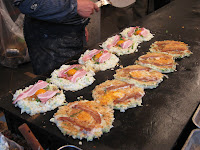
This is a picture of a guy preparing okonomiyaki, a tasty treat made out of stuff like shredded cabbage, onions, bacon, and eggs. It's kind of like an omelet, I suppose, so you can pretty much put anything in it that you want. Okonomiyaki will always have a small place in my heart because it's the first food I had when I arrived in Miyazaki, the prefecture that I live in. There were some things on the menu that I recognized, but I'm glad I chose something new. In case you didn't know, I have quite an adventurous spirit!
Can you find your name? I can't find mine, but some people certainly found theirs. I asked some girls about this wall of names. From what I gather, you deposit 100 yen, find your name, and grab the fortune. There's a similar kind of fortune called omikuji. If you get a good fortune, you keep it. If you get a bad one, you hang it up on a tree or rope or whatever before leaving the shrine so that your curse stays behind. The Japanese sure are a superstitious lot, eh? If life were only so easy!

Nara is known for its deer, and sure enough, I spotted quite a few of them. They are quite tame, so it's easy to pet them, even though they don't necessarily like that. And you can feed them, too. Vendors sell stacks of special deer food wafers for about 150 yen. During the day, I didn't see too many of them, but at night, I saw several little herds of 20-30 deer. And if you slowly approached, they didn't get startled at all. Seeing so many tame deer at once is quite an amazing sight.

This is a picture of a snack called "kaitenyaki." It's basically a pancake filled with that omnipresent "Japanese chocolate" called anko. Each pancake cost 100 yen and I bought 2 of them. I can't exactly say they were delicious, but they were good. There's almost no way to escape eating anko over here, and the more I eat it, the more I like it. Or do I?
Here's a picture of a five-tiered pagoda in Nara. You'll have to trust me on the five-tier bit, since only three tiers are visible in the picture. There's something about the five-tiered pagodas that I really like. Maybe it's the fact that they say to me, "Hey, man, it's true, you really are in Japan!" I saw at least two more of them in Kyoto and even went out of my way to find one of them.

This is a picture of perhaps the most famous sight in Kyoto, the kinkakuji, or Golden Pavilion. I went there on my last day full day in the Kansai area. I almost decided against going to see this beautiful pavilion, because by that time I had done my fair share of sightseeing. Besides, the location was a bit out of the way. But, remarkably, the entrance fee was only 400 yen, so I thought I'd go for it. I'm glad I did, too. I think it's important for me to see the sights that are important to my Japanese neighbors.

Yes, they do have bread in Japan! Unfortunately, the majority of the bread you find is white, like the rice. But on occasion, you really can find some healthy and delicious whole-wheat bread or even rye bread. Before I went on this trip, I heard that the bread in the Kansai area was great and I must say, I wasn't disappointed. But lucky for me, there are even some decent bakeries closer to home for those rare times when I don't feel like eating a bowl of rice. Hee hee.

One night, while walking back to my hotel in Osaka, I came across a guy doing some calligraphy. I'm not sure if his work has any special significance, but calligraphy is certainly a big part of Japanese culture. I'm even taking a class, once a week on Tuesdays. This guy worked fast and made it look so easy!

It's the Year of the Mouse here in Japan, which must mean it's the Year of the Rat in China. Hmmm. I prefer mice to rats any day. I'm not sure exactly what these things in the picture are called (ema boards?), but people purchase them, write a message/prayer on them, and then hang them up. I have a feeling that they are then burned eventually, because I saw lots of other items left to be burned. The were plenty of other mice souvenirs for sale at most shrines and temples and they were selling like hotcakes.

This is a picture of a guy preparing okonomiyaki, a tasty treat made out of stuff like shredded cabbage, onions, bacon, and eggs. It's kind of like an omelet, I suppose, so you can pretty much put anything in it that you want. Okonomiyaki will always have a small place in my heart because it's the first food I had when I arrived in Miyazaki, the prefecture that I live in. There were some things on the menu that I recognized, but I'm glad I chose something new. In case you didn't know, I have quite an adventurous spirit!

Can you find your name? I can't find mine, but some people certainly found theirs. I asked some girls about this wall of names. From what I gather, you deposit 100 yen, find your name, and grab the fortune. There's a similar kind of fortune called omikuji. If you get a good fortune, you keep it. If you get a bad one, you hang it up on a tree or rope or whatever before leaving the shrine so that your curse stays behind. The Japanese sure are a superstitious lot, eh? If life were only so easy!

Nara is known for its deer, and sure enough, I spotted quite a few of them. They are quite tame, so it's easy to pet them, even though they don't necessarily like that. And you can feed them, too. Vendors sell stacks of special deer food wafers for about 150 yen. During the day, I didn't see too many of them, but at night, I saw several little herds of 20-30 deer. And if you slowly approached, they didn't get startled at all. Seeing so many tame deer at once is quite an amazing sight.

This is a picture of a snack called "kaitenyaki." It's basically a pancake filled with that omnipresent "Japanese chocolate" called anko. Each pancake cost 100 yen and I bought 2 of them. I can't exactly say they were delicious, but they were good. There's almost no way to escape eating anko over here, and the more I eat it, the more I like it. Or do I?

Here's a picture of a five-tiered pagoda in Nara. You'll have to trust me on the five-tier bit, since only three tiers are visible in the picture. There's something about the five-tiered pagodas that I really like. Maybe it's the fact that they say to me, "Hey, man, it's true, you really are in Japan!" I saw at least two more of them in Kyoto and even went out of my way to find one of them.

This is a picture of perhaps the most famous sight in Kyoto, the kinkakuji, or Golden Pavilion. I went there on my last day full day in the Kansai area. I almost decided against going to see this beautiful pavilion, because by that time I had done my fair share of sightseeing. Besides, the location was a bit out of the way. But, remarkably, the entrance fee was only 400 yen, so I thought I'd go for it. I'm glad I did, too. I think it's important for me to see the sights that are important to my Japanese neighbors.

Yes, they do have bread in Japan! Unfortunately, the majority of the bread you find is white, like the rice. But on occasion, you really can find some healthy and delicious whole-wheat bread or even rye bread. Before I went on this trip, I heard that the bread in the Kansai area was great and I must say, I wasn't disappointed. But lucky for me, there are even some decent bakeries closer to home for those rare times when I don't feel like eating a bowl of rice. Hee hee.

Monday, February 4, 2008
Short stories about my year-end trip to Kansai -- Part 1.
The photos below are from my year-end trip to the Kansai region, which includes Kyoto, Osaka, Kobe, and Nara.
There are a ton of temples and shrines in Kyoto. Sometimes, while I was walking or riding from one shrine to the next, I thought to myself, "If you've seen one shrine/temple, you've seen them all." But that's not true. Each one has its own charm and beauty. For instance, some are huge, while others are tiny. Some are high on the hillside, while others are smack dab in the middle of town. Some are in fantastic condition, while others show their age. And some are overflowing with tourists, while others are practically abandoned.

Before I came to Kyoto, I had seen several women in kimonos elsewhere in Japan (and even in America). But seeing women in kimonos in Kyoto is, well, cooler, because you expect to see them there, but you still have to be in the right place at the right time to spot them. I guess it's like going to Disneyland and actually getting to see Mickey Mouse. These two young ladies were a bit shy, but they were kind enough to take a picture with me. I tried asking them why they were wearing the kimonos, but I had a tough time understanding them. Had this been in America, I'm pretty sure my arms would have been draped around their shoulders, but as I mentioned in an earlier blogspot, touchy-feely is not a big part of Japanese culture.

From what I understand, New Year's is the most important holiday to the Japanese. So just about every shrine and temple was jam-packed with people were showed up to donate money, pray for good luck, and purchase various souvenirs. One of the most popular souvenirs was these arrows. I guess I should be telling you their significance, but I still don't know that. In any case, they are expensive. Those shorter ones are 22,000 yen, or about $200, and those longer ones are 22,500 yen, 0r about 5 bucks more. I chose a tiny little mouse (it's the year of the mouse!) for 500 yen. Do you see the price tags? The numbers are written from top to bottom.

I didn't realize that Osaka was completely different from Kyoto until I got there. Osaka is basically a modern city with far fewer cultural attractions than its neighbor to the north. But the Osaka castle is really impressive. The castle was closed, so I wasn't able to go inside, but I still enjoyed walking around the grounds. The castle area was the first place I went in Osaka. Later, I realized that the castle grounds offered a relaxing alternative to the other, more fast-paced parts of town.

The ginkakuji, or Silver Pavilion, is one of the most famous sights in Kyoto, so you have to pay to get in (500 yen). I must say, though, that I wasn't overly impressed by the pavilion. The grounds were kept in immaculate shape, and there were some beautiful sand sculptures, but I wasn't awed by anything. I did really like the view from above the pavilion grounds, however. It reminded me a lot of San Francisco, with the hills, trees, clouds, and blue sky.

Just before the New Year arrived, I started seeing these two- and three-high piles of mochi, topped with a mandarin orange all over the place. They are called kagami mochi. Sometimes the mochi is real and wrapped in thin plastic, but it's often fake. In a sense, they are like little Japanese snowmen and are pleasant to look at.

This is the entrance to one of the larger temples near the main train station in Kyoto. I took this picture around 4:20 p.m. If you plan to go a bunch of temples and shrines, but don't have much time, make sure get an early start since many of them close at 4:30. Whatever hidden treasures this place has to offer will have to wait for another day.

This is a picture of a bunch of Japanese stone lanterns called tourous. They can be found at many shrines, temples, and gardens. You'll often see them at night with candles burning inside the top.

I took this photo on the grounds of the Sanjusangendo Temple, another one of the most famous sights in Kyoto that has an entrance fee (600 yen). This picture shows one of the many sights that you expect to find when you go to Japan.

This picture shows some baby-like stone figures in front of a pool of cleansing water. I saw a lot of these figures, all wearing red aprons. Apparently, the children are waiting to go to Heaven. When they are given white aprons, then they are ready to go.
There are a ton of temples and shrines in Kyoto. Sometimes, while I was walking or riding from one shrine to the next, I thought to myself, "If you've seen one shrine/temple, you've seen them all." But that's not true. Each one has its own charm and beauty. For instance, some are huge, while others are tiny. Some are high on the hillside, while others are smack dab in the middle of town. Some are in fantastic condition, while others show their age. And some are overflowing with tourists, while others are practically abandoned.

Before I came to Kyoto, I had seen several women in kimonos elsewhere in Japan (and even in America). But seeing women in kimonos in Kyoto is, well, cooler, because you expect to see them there, but you still have to be in the right place at the right time to spot them. I guess it's like going to Disneyland and actually getting to see Mickey Mouse. These two young ladies were a bit shy, but they were kind enough to take a picture with me. I tried asking them why they were wearing the kimonos, but I had a tough time understanding them. Had this been in America, I'm pretty sure my arms would have been draped around their shoulders, but as I mentioned in an earlier blogspot, touchy-feely is not a big part of Japanese culture.

From what I understand, New Year's is the most important holiday to the Japanese. So just about every shrine and temple was jam-packed with people were showed up to donate money, pray for good luck, and purchase various souvenirs. One of the most popular souvenirs was these arrows. I guess I should be telling you their significance, but I still don't know that. In any case, they are expensive. Those shorter ones are 22,000 yen, or about $200, and those longer ones are 22,500 yen, 0r about 5 bucks more. I chose a tiny little mouse (it's the year of the mouse!) for 500 yen. Do you see the price tags? The numbers are written from top to bottom.

I didn't realize that Osaka was completely different from Kyoto until I got there. Osaka is basically a modern city with far fewer cultural attractions than its neighbor to the north. But the Osaka castle is really impressive. The castle was closed, so I wasn't able to go inside, but I still enjoyed walking around the grounds. The castle area was the first place I went in Osaka. Later, I realized that the castle grounds offered a relaxing alternative to the other, more fast-paced parts of town.

The ginkakuji, or Silver Pavilion, is one of the most famous sights in Kyoto, so you have to pay to get in (500 yen). I must say, though, that I wasn't overly impressed by the pavilion. The grounds were kept in immaculate shape, and there were some beautiful sand sculptures, but I wasn't awed by anything. I did really like the view from above the pavilion grounds, however. It reminded me a lot of San Francisco, with the hills, trees, clouds, and blue sky.

Just before the New Year arrived, I started seeing these two- and three-high piles of mochi, topped with a mandarin orange all over the place. They are called kagami mochi. Sometimes the mochi is real and wrapped in thin plastic, but it's often fake. In a sense, they are like little Japanese snowmen and are pleasant to look at.

This is the entrance to one of the larger temples near the main train station in Kyoto. I took this picture around 4:20 p.m. If you plan to go a bunch of temples and shrines, but don't have much time, make sure get an early start since many of them close at 4:30. Whatever hidden treasures this place has to offer will have to wait for another day.

This is a picture of a bunch of Japanese stone lanterns called tourous. They can be found at many shrines, temples, and gardens. You'll often see them at night with candles burning inside the top.

I took this photo on the grounds of the Sanjusangendo Temple, another one of the most famous sights in Kyoto that has an entrance fee (600 yen). This picture shows one of the many sights that you expect to find when you go to Japan.

This picture shows some baby-like stone figures in front of a pool of cleansing water. I saw a lot of these figures, all wearing red aprons. Apparently, the children are waiting to go to Heaven. When they are given white aprons, then they
 are ready to go.
Subscribe to:
Posts (Atom)
